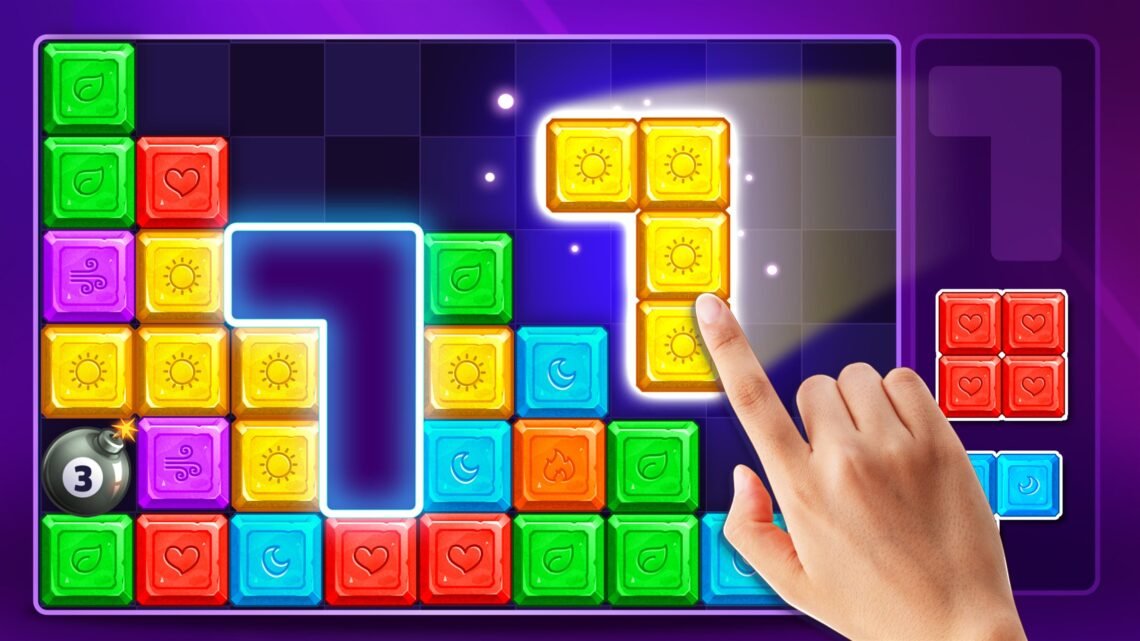
Did you know that the simple act of playing with blocks can significantly boost a child’s cognitive abilities? Block games, from simple stacking to complex construction challenges, offer a unique and engaging way to develop critical thinking and problem-solving skills. These games are more than just playtime; they are foundational learning experiences.
The Building Blocks of Problem-Solving
At its core, problem-solving involves identifying an issue, devising a strategy, implementing it, and evaluating the outcome. Block games provide a tangible and interactive environment for practicing these steps. When a child attempts to build a tower, they are immediately faced with a problem: how to make it stand tall without toppling over. This simple goal requires them to think about balance, stability, and the properties of different shapes.
Spatial Reasoning and Planning
Playing with blocks naturally encourages the development of spatial reasoning. Children learn to understand how objects fit together, their relative positions, and how they occupy space. This is crucial for visualizing solutions to problems. Before placing a block, a child might mentally picture where it will go and how it will affect the overall structure. This foresight is a key component of planning, another vital problem-solving skill. They learn to anticipate consequences and adjust their approach accordingly.
Trial and Error and Adaptation
Mistakes are an inevitable part of block play. A tower might fall, or a structure might not look as intended. These moments are not failures but opportunities for learning. Children engage in trial and error, experimenting with different block placements and configurations. When one approach doesn’t work, they are encouraged to adapt their strategy and try something new. This process teaches resilience and the understanding that there can be multiple solutions to a single problem. This iterative process is a cornerstone of effective problem-solving.
Creativity and Innovation
Beyond just stability, block games also foster creativity. Children can invent unique structures, imagine scenarios, and bring their ideas to life. This creative freedom allows them to explore unconventional solutions and think outside the box. When faced with a challenge, such as building a bridge or a house, they can draw upon their imagination to devise novel designs. This ability to generate new ideas is directly transferable to solving real-world problems.
Engaging with Block Games
There are numerous ways to incorporate block games into learning and development. Simple stacking games are great for younger children, while more complex building sets can challenge older kids. Games like Google Block Breaker can also offer unique challenges that require strategic thinking and quick reflexes, further honing problem-solving abilities. The key is to provide a variety of blocks and encourage exploration and experimentation. For a deeper dive into cognitive development, resources from Wikipedia can offer further insights. Understanding the principles behind effective problem-solving, as discussed by Harvard Business Review, can also inform how we approach these activities.
Conclusion
Block games are an invaluable tool for nurturing problem-solving skills in children. They provide a fun, hands-on platform for developing spatial reasoning, planning, resilience, and creativity. By engaging with blocks, children learn to approach challenges with confidence, experiment with solutions, and adapt to overcome obstacles, setting them up for success in all areas of life.